What Is Colour?
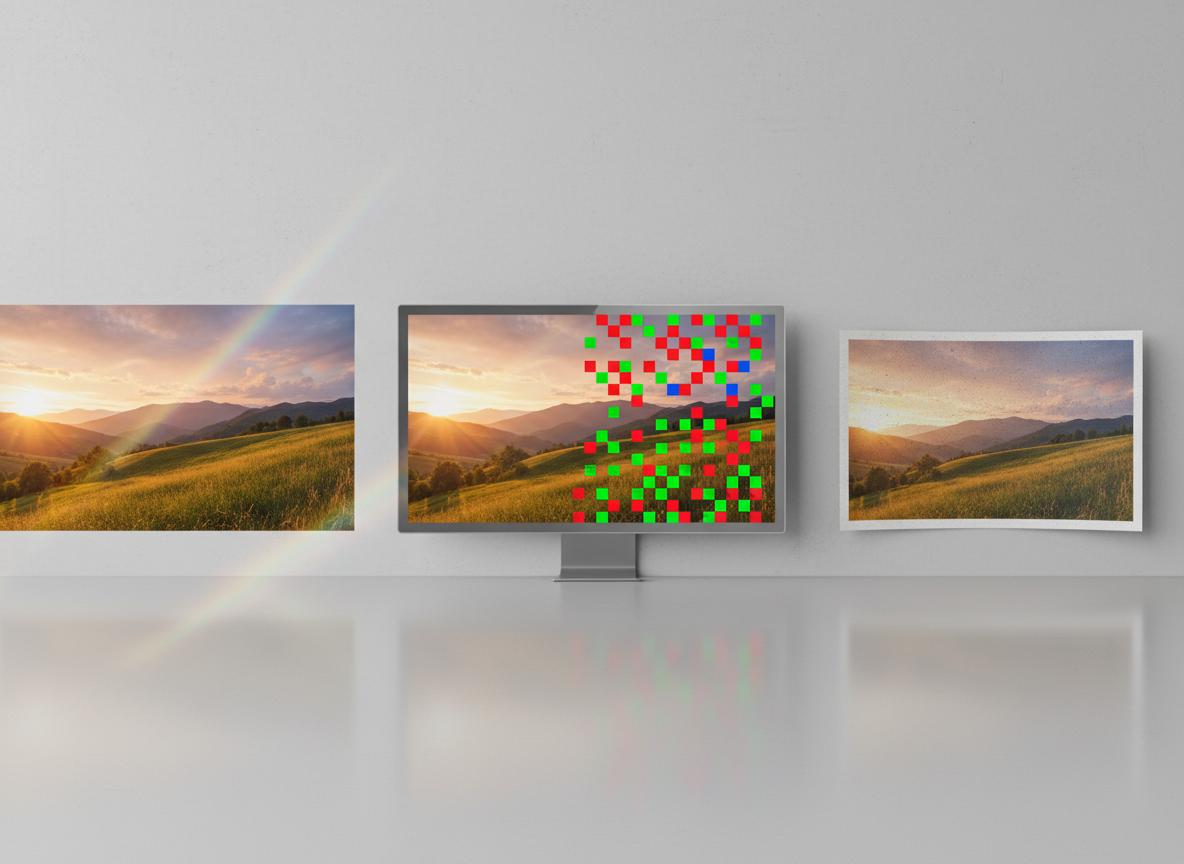
Colour feels obvious. We look at the world and we see blue skies, green grass, red post boxes. It is so familiar that we rarely stop to ask a basic question: what actually is colour?
In physical terms, colour does not exist as an object. What exists is light. Light from the sun or an artificial source hits a surface, and that surface absorbs some wavelengths and reflects others. The reflected light enters our eyes and is interpreted by our brains as colour. Change the light source, and the colour changes—even though the object itself has not.
This is why a white wall can look warm and creamy at sunset, cold and blue in shade, or slightly green under fluorescent lighting. The wall hasn’t changed. The light has.
Colour and Human Vision
Our eyes contain two main types of light-sensitive cells: rods and cones. Rods are sensitive to brightness and allow us to see in low light, but they do not detect colour. Cones are responsible for colour vision and respond to different ranges of wavelengths that we loosely describe as red, green, and blue.
Already, colour is a biological interpretation, not a fixed reality. Two people can look at the same scene and perceive colour slightly differently. As we age, our lenses yellow, subtly altering colour perception. Fatigue, context, and surrounding colours all influence what we think we see.
So when we talk about “accurate colour,” we are already on shaky ground.
Colour on Screens
Digital screens—phones, tablets, computers—do not display colour by reflecting light. They emit light. Each pixel is made up of red, green, and blue sub-pixels, mixed in varying intensities to trick our eyes into seeing millions of colours.
This system works remarkably well, but it comes with consequences. Screens vary enormously in brightness, contrast, and colour calibration. The same image can look warm and rich on one screen, cool and flat on another, and garish on a third. Even viewing conditions matter: a dim room versus bright daylight will change how colours appear.
When you edit a photograph, you are making decisions based on your screen, your lighting, and your eyesight—not on some absolute truth.
Colour in Print
Print introduces another transformation. Printed images rely on reflected light, using inks or pigments to absorb and reflect wavelengths. This is a completely different process from screen display.
Anyone who has been disappointed by a print compared to what they saw on screen has already experienced this gap. Blacks can block up, shadows lose subtle colour, and vibrant screen colours may appear muted on paper. Paper type, ink, printer profiles, and viewing light all play a role.
A print viewed under warm indoor lighting will look different from the same print viewed in daylight. Once again, colour is not fixed—it is conditional.
Colour in Photography
Cameras complicate things further. Digital sensors do not “see” colour as we do. They measure light intensity through coloured filters and then rely on software to reconstruct a colour image. White balance, colour profiles, and tone curves are all applied before you ever see the photograph.
Even when shooting RAW, the preview you see on the back of the camera has already been interpreted. And if you shoot JPEG, the camera has made many creative decisions on your behalf.
This is why colour is such a powerful—and slippery—creative tool. A photograph is never a simple record of reality. It is an interpretation layered upon an interpretation.
Why This Matters
Understanding that colour is contextual, interpretive, and variable frees us from chasing a mythical “correct” result. Instead, it invites us to ask a better question: what do I want this image to feel like?
Over the coming weeks, we’ll look at colour temperature and tint—two simple controls that allow you to steer mood and meaning rather than accept the camera’s assumptions. Once you realise there is no single, standard colour, taking control becomes less intimidating and far more creative.