Exploring Ultra Macro
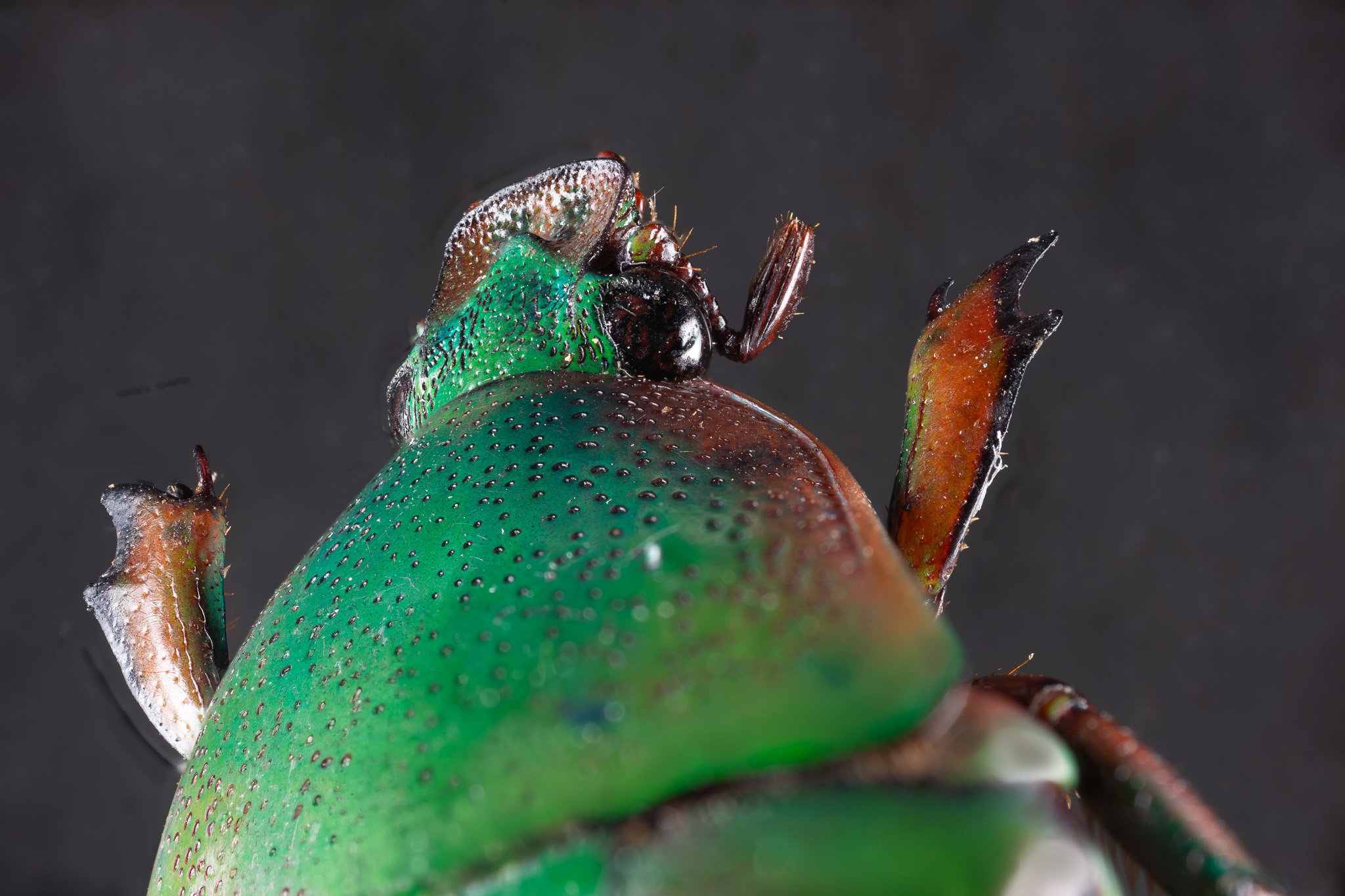
Focus stacked Image looking down on the beetle, 201 slices and it is still only partially in focus.
Last week I mentioned that I'd been experimenting with ultra-macro photography. Since then I've taken several hundred photographs, but I still wasn't achieving the quality I was looking for. Eventually I realised I was approaching the problem the wrong way. Rather than relying on trial and error, I needed to understand the mathematics first and then apply a little engineering common sense.
I knew I needed to combine focus stacking with image mosaics, but I had no idea how many photographs that really meant, or how far I should move the camera between each one. Guesswork clearly wasn't working.
My new specimen (purchased online after last week's unfortunate moth disintegrated!) is about 10 mm long, 10 mm wide and about 5 mm deep.
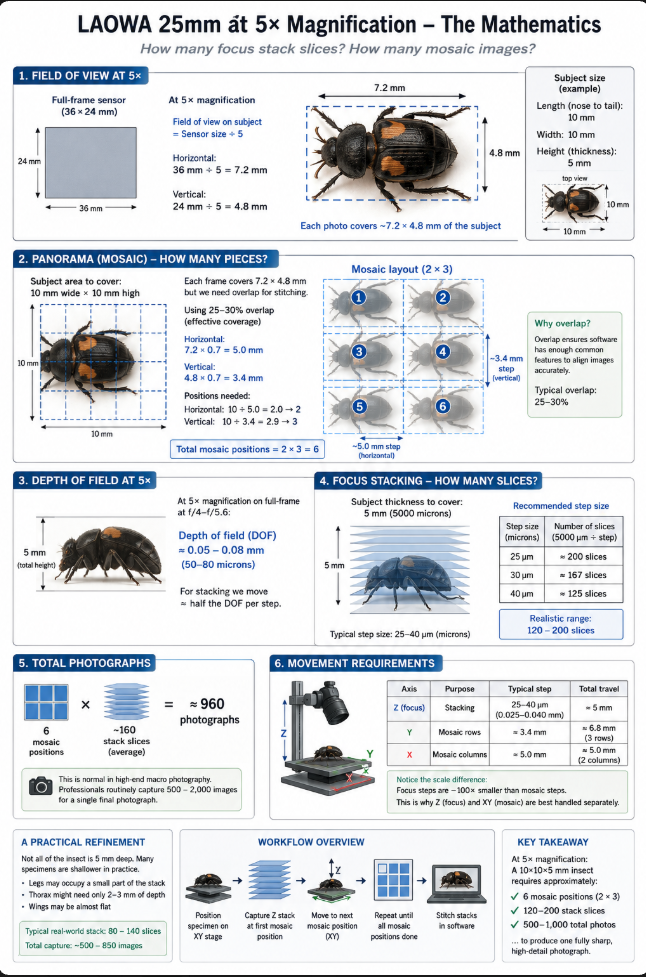
At 5× magnification my full-frame camera, with its 36 × 24 mm sensor, can only photograph an area about 7.2 × 4.8 mm on the beetle. That's smaller than the beetle itself, so one photograph simply isn't enough. Allowing for overlap so that the software can stitch the images together, I need a grid of 2 photographs across and 3 down—six photographs in total before I even think about focus stacking.
The arithmetic was a real eye-opener. Each of the six mosaic positions needs around 160 focus-stack images, giving a grand total of almost 1,000 photographs to produce a single finished image of one tiny beetle.
Suddenly the engineering made perfect sense. The challenge isn't taking one photograph—it's building one from almost a thousand precisely aligned images, each separated by just thirty thousandths of a millimetre.
That is a lot of photographs and a lot of tiny adjustments on the new rig I have been building today using an old copy stand and some focusing rails. The engineering project will continue next week.
If you have not lost the will to live on this subject, I have summarised the calculations in the attached info graphic. (click image to open as pdf)